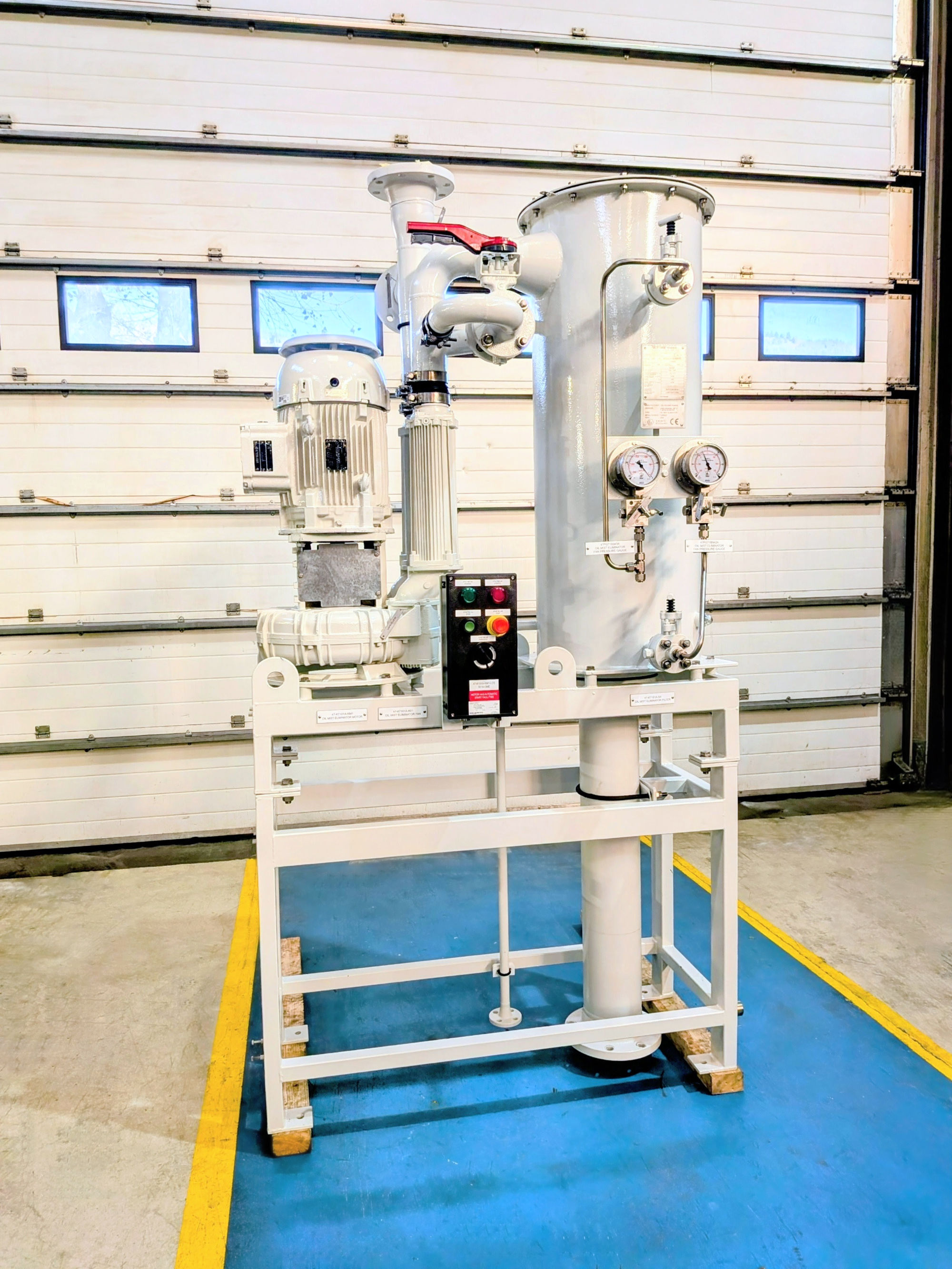
We recently designed and manufactured an industrial oil separator intended for a lubrication unit produced by OELTECHNIK-France, installed in an ATEX Zone 2 IIA T3 area. This equipment meets the high demands of the oil and gas industry, where reliability, material quality and efficient oil/air separation processes are essential.
An Industrial Oil Separator Built in Dual-Marked 316/316L Stainless Steel
To ensure optimal resistance in harsh operating environments, the oil separator is manufactured using:
- 316/316L dual-marked stainless steel
- Certified and fully traceable quality for oil and gas applications
- Material perfectly suited for lubrication systems
TSA Coating and Client-Specific Paint System
High-Durability Thermal Coating
The equipment is protected with a TSA (Thermal Spray Aluminium) coating, known for its corrosion resistance and outstanding service life.
Applying TSA requires an adapted design approach, including:
- optimised access areas,
- geometry with no shadow zones,
- surface preparation to ensure proper adhesion,
- integration of handling points to assist the application process.
Paint System According to Client Specifications
A finishing paint layer, compliant with the client’s requirements, completes the protective system of the oil separator.
Instrumentation: Pressure Gauges, Local Panel and Monoflange Valves
The oil separator is equipped with a local instrumentation panel, including:
- Pressure gauges
- Monoflange isolation valves, reducing leak paths and simplifying maintenance
These valves were selected for their compactness, reliability, and their ability to minimise potential leak points — a key requirement in oil and gas applications.
Monel 400 Tubing for High Performance in Severe Environments
To ensure maximum reliability of the instrumentation, all tubing is made of Monel 400, a nickel–copper alloy valued for:
- its extreme corrosion resistance,
- its mechanical strength in oil and gas environments,
- its durability in industrial lubrication systems.
Quality Controls: PMI, Seismic Calculation, 10% RT and Dye Penetrant Testing
To guarantee compliance and safety, several inspections were conducted:
- PMI (Positive Material Identification) on critical components
- Seismic calculation according to the applicable standards
- 10% radiographic testing (RT) of welds
- Dye penetrant testing on lifting lugs to secure handling operations
These steps ensure full traceability and outstanding manufacturing quality.
Full Integration on an OELTECHNIK-France Lubrication Unit
Mechanical Installation and Electrical Connection
The oil separator was directly installed on the lubrication unit, including:
- mechanical mounting,
- electrical connection,
- full compliance with ATEX Zone 2 IIA T3 requirements.
Workshop Testing
Complete factory tests were performed prior to shipment to guarantee quick and reliable plug-and-play installation on the client’s site.
FAQ – Industrial Oil Separators & Lubrication Units
What is an industrial oil separator?
An oil separator is a device used to separate oil from an airflow. It is commonly used in lubrication units, compressors, pumps, turbines and oil and gas installations.
Why use an oil separator in a lubrication unit?
It ensures fluid quality, protects downstream equipment and increases the operational lifetime of the lubrication system.
Which materials are suitable for oil and gas environments?
316/316L stainless steel, Monel 400, nickel–copper alloys and TSA coatings are particularly well-suited due to their corrosion resistance and robustness in aggressive atmospheres.
Can the oil separator be ATEX certified?
Yes. This model is specifically designed for installation in ATEX Zone 2 IIA T3, with compliant materials, instrumentation and electrical connections.
What quality control steps are included?
Depending on project requirements: PMI, non-destructive testing (RT, dye penetrant), seismic assessment, pressure testing, electrical tests and final inspection.
Can an oil separator be adapted to an existing design?
Yes. We design custom oil separators to match existing lubrication units (dimensions, instrumentation, flow capacity, materials).